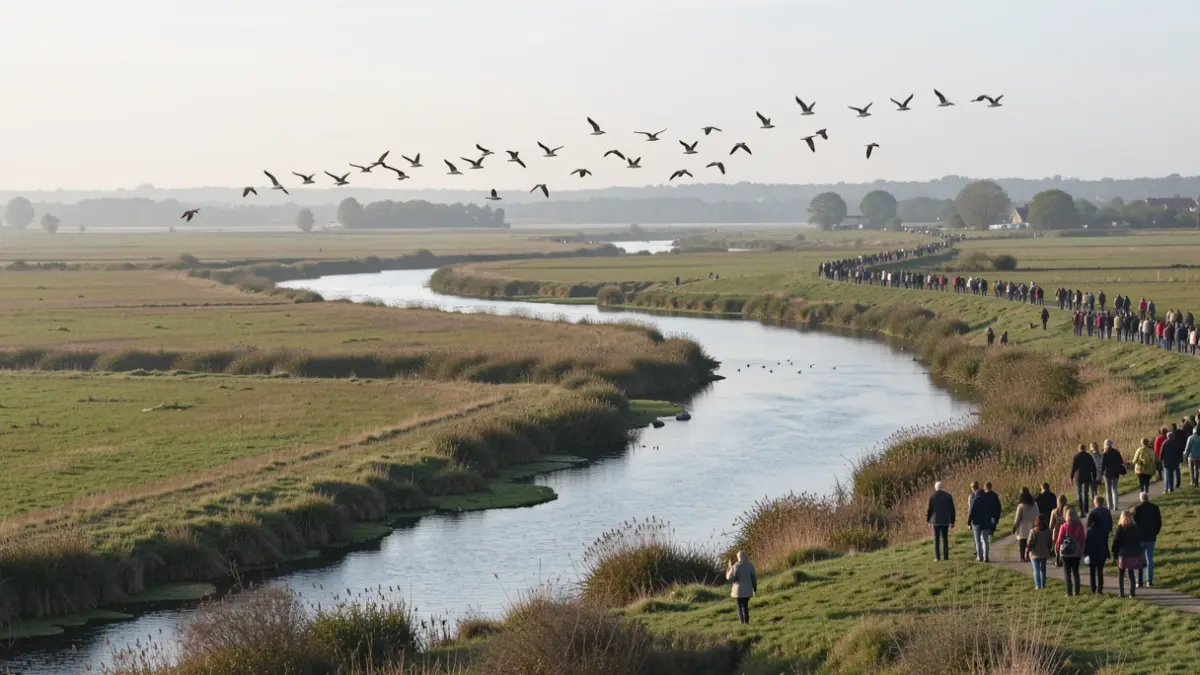
Every autumn, millions of birds traverse Europe, covering thousands of kilometers between their breeding grounds and wintering quarters. To complete this journey, they rely on precious stopovers for rest and feeding. The Yvelines, with its wetlands, ponds, and preserved natural spaces, plays a crucial role as a refuge territory, actively contributing to the preservation of biodiversity and major European migration routes.
Although Île-de-France is not situated on the main coastal migratory routes, many species regularly choose the natural spaces of Yvelines. Wetlands, ponds, reed beds, banks of the Seine, and floodplain meadows offer the water, abundant food, and tranquility needed to replenish their energy reserves before continuing their journey.
The Common Snipe (Bécassine des marais), a wader with a long beak, is a regular visitor to the Parc du Peuple de l’herbe in Carrières-sous-Poissy, stopping over in October. Scientific monitoring by the Ligue pour la Protection des Oiseaux (LPO) indicates that this site serves as a migratory stopover, and potentially a wintering ground, thanks to the ripisylve, reed beds, and wetlands of the park.
To facilitate the Common Snipe's stay, a portion of the reed bed is mown each autumn. This ecological management creates clear areas, making it easier for the birds to find food while maintaining access to water.
The 'Bout du Monde' site, at the confluence of the Seine and Oise rivers, is another favored location, designated as an LPO Refuge. Its three observatories allow for discreet observation of wildlife and migratory birds, highlighting the Department's commitment to preserving natural habitats.
Birds choose their stopover sites based on three fundamental needs: feeding, drinking, and resting safely. The natural spaces of the Yvelines precisely meet these essential conditions.
The National Nature Reserve of the Ponds and Ditches of Yveline, constructed between 1675 and 1685 to supply the Palace of Versailles, now collects and stores water from the Rambouillet plateau, thus draining agricultural and urbanized areas. It hosts numerous species of aquatic birds and serves as a vital stopover for transit birds.
The Department's commitment to biodiversity, through sites like the Parc du Peuple de l’herbe, the Bout du Monde, and the Étangs et Rigoles, supports these 'travelers of the sky' in their journey, underscoring the vital importance of these stops on Europe's biodiversity routes.