The Institut Polytechnique de Paris (IP Paris), comprising six schools including the École polytechnique, ENSTA, the École nationale des ponts et chaussées, ENSAE Paris, Télécom Paris, and Télécom SudParis, has unveiled its new development strategy. The institute aims to bolster its ambitions around major scientific and technological challenges such as defense and sovereignty, ecological and energy transitions, and artificial intelligence and disruptive technologies.
Facing increased international competition, IP Paris relies on three levers: transforming its campus, investing in high-risk research and disruptive innovation, and a strengthened talent attraction policy, with a reinforced European presence and new cooperation priorities in Asia.
« In just a few years, we have made IP Paris a leading science and technology institute on the global stage. Faced with the major challenges of our time, we have a responsibility: to mobilize all our scientific power to produce knowledge and solutions that meet society's needs », states Thierry Coulhon, President of the Executive Board of IP Paris.
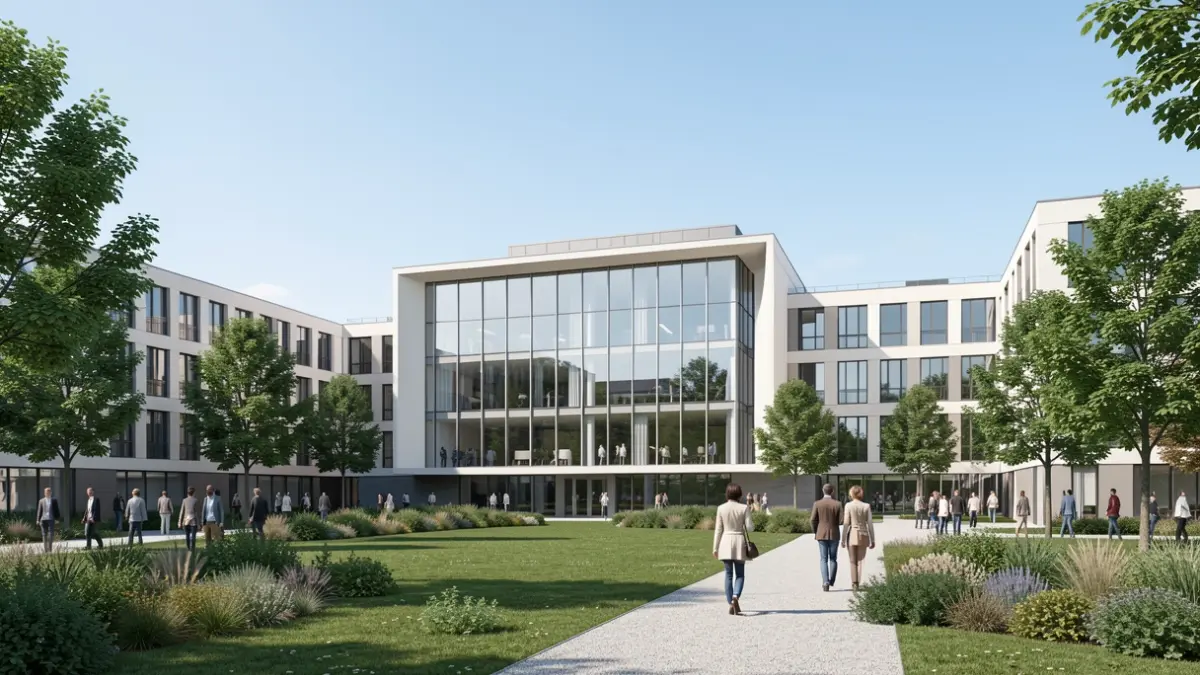
The campus in Palaiseau is undergoing significant transformation with numerous real estate projects aimed at improving reception and living conditions. The site also benefits from the broader development of Paris-Saclay, including the arrival of Metro Line 18. IP Paris also maintains locations in Évry, Champs-sur-Marne, and Brest to stay close to its schools' expertise.
Defense and sovereignty are core to IP Paris's identity. The Ministry of Armed Forces is strengthening its activities on campus with the research hub of the Ministry's Agency for Defense Artificial Intelligence (AMIAD), inaugurated on March 4, 2025. The creation of a Defense Institute, funded with €15 million by the ministry, is planned to integrate research, training, and innovation, notably bringing together the AMIAD hub, IP Paris's Interdisciplinary Center for Defense and Security Studies (CIEDS), and cybersecurity specialized teams.
Concrete examples illustrate this commitment: the École polytechnique offers a mandatory course on defense and sovereignty, and a cybersecurity bachelor's degree. ENSTA, with ISAE-SUPAERO, has launched a unique Defense & Security engineering program. Télécom SudParis offers a Digital Defense and Sovereignty track. The ASC Chair now permeates the training programs of the four schools.
IP Paris aims to make robotics a field of excellence, drawing on 51 teacher-researchers. Applications span defense, maritime, industry, and construction. The institute boasts the Defense Robotics and Artificial Intelligence Laboratory (LARIAD) and experimental platforms, including an air-sea experimentation basin in Brest and a future drone arena in Palaiseau. A partnership with ONERA, formalized in December 2025, will consolidate this ecosystem.
The campus is becoming a testing ground for the ecological transition. Demonstrators are testing decarbonization solutions, such as [AXEN] (60% energy consumption reduction) and [XSeaO2] (CO₂ valorization). The [Rénov’X] project aims to renovate the central building of the École Polytechnique. The École nationale des ponts et chaussées will move into the future "Le Central" building by 2029.
IP Paris is working on creating an Institute for Electrification Technologies with the CEA and IFPEN. The École nationale des ponts et chaussées will play a central role. The institute aims to facilitate the transition from research to industrialization of technologies.
A new Institute for Mathematics and Fundamental Sciences, made possible by the commitment of Bernard Arnault, will open in Palaiseau by 2030. A new building dedicated to physics will house teams from the Laboratory of Interfaces and Thin Films Physics (LPICM) and the Leprince-Ringuet Laboratory (LLR), scheduled for early 2028 on the X campus.
The FRONTIERS program, launched in 2026, commits €2.25 million to fund exploratory research. 15 projects were selected, each receiving €150,000 for up to 48 months.
The Innovation Lab at IP Paris, established in 2025, identifies and supports innovative projects. The institute invests nearly €1 million annually in the pre-maturation of deeptech projects. Five incubators and seed funds like Polytechnique Ventures support over 120 startups annually.
IP Paris is strengthening its international strategy to attract top talent. The goal is to focus efforts on partnerships that yield concrete and sustainable scientific collaborations. The institute is chairing EuroTech in 2026 and launching the EuroTech 2030 strategy. The alliance will expand to include two new members: CTU (Prague) and TalTech (Tallinn).
Targeted partnerships are being developed in Europe, notably with KTH in Sweden and the AI Corridor with Oxford and Cambridge. IP Paris also participates in the EELISA alliance through the École nationale des ponts et chaussées.
In Asia, India is a key partner with strengthened cooperation in AI. Ties are growing in Japan with the University of Tokyo and in South Korea with Seoul National University and Yonsei University. Seed funding mechanisms support 15 joint scientific projects.
43% of IP Paris students are international. The institute saw a 15.5% increase in Master's and PhD Track students this 2026 academic year. Over 1,300 students will graduate from an AI program in 2026. Télécom SudParis is launching a new certificate in artificial intelligence.
The multidisciplinary undergraduate program (CPES) Paris-Saclay prepares students for high-level studies. The Equality Observatory, launched with the ENS, aims to analyze factors hindering young people's access to scientific fields. Research project OrienteXpress seeks to improve scientific career guidance.
In a highly competitive international landscape, IP Paris is enhancing its ability to attract and retain researchers. The Gaspard Monge Visiting Professor program hosts top-level researchers annually. Hi! PARIS has expanded since 2024, recruiting 11 external chair holders and 11 additional faculty members.
The 2026-2027 period will be significant institutionally: a joint President of the Board with the École polytechnique will be appointed in autumn 2026. The Performance Objectives Contract for 2027-2031 will be drafted, and IP Paris will transition to a 'grand établissement' status in early 2027, following a favorable review by Hcéres on September 7, 2026.