Between June 1st and September 23rd, 2026, the Yerres watershed recorded only 60 mm of rain, considerably less than the average 244 mm for this period, representing a 75% decrease in precipitation.
The SyAGE's Telemanagement and Information Processing (TTI) service analyzed the available pluviometric and hydrometric data, revealing a concerning hydrological situation. Riad Bechar, head of the service, highlighted the unique nature of this summer: « This summer, the rainfall deficit was particularly pronounced: only 60 mm were recorded between June 1st and September 23rd, compared to an average of 244 mm ».
Out of the 115 days studied, only 13 were rainy. The situation worsened in September, with no rainfall recorded until the 23rd of the month.
This scarcity of rain led to a sharp decline in river flow rates. In Courtomer, upstream of the Yerres, the average flow dropped to 0.04 m³/s (from an average of 0.39 m³/s), an 89% decrease. Minimum flows reached just 2 liters per second in August and September.
Further downstream, in Boussy-Saint-Antoine, the average flow was 0.4 m³/s, a 71% reduction from the usual average of 1.4 m³/s. The Réveillon stream was also severely impacted, with an average flow deficit of 85% in Férolles-Attilly, and minimums of only 4 liters per second in July and August.
Riad Bechar added: « These flow levels indicate a particularly severe situation across the entire basin, with conditions favorable for the appearance and worsening of dry spells in the most sensitive areas ».
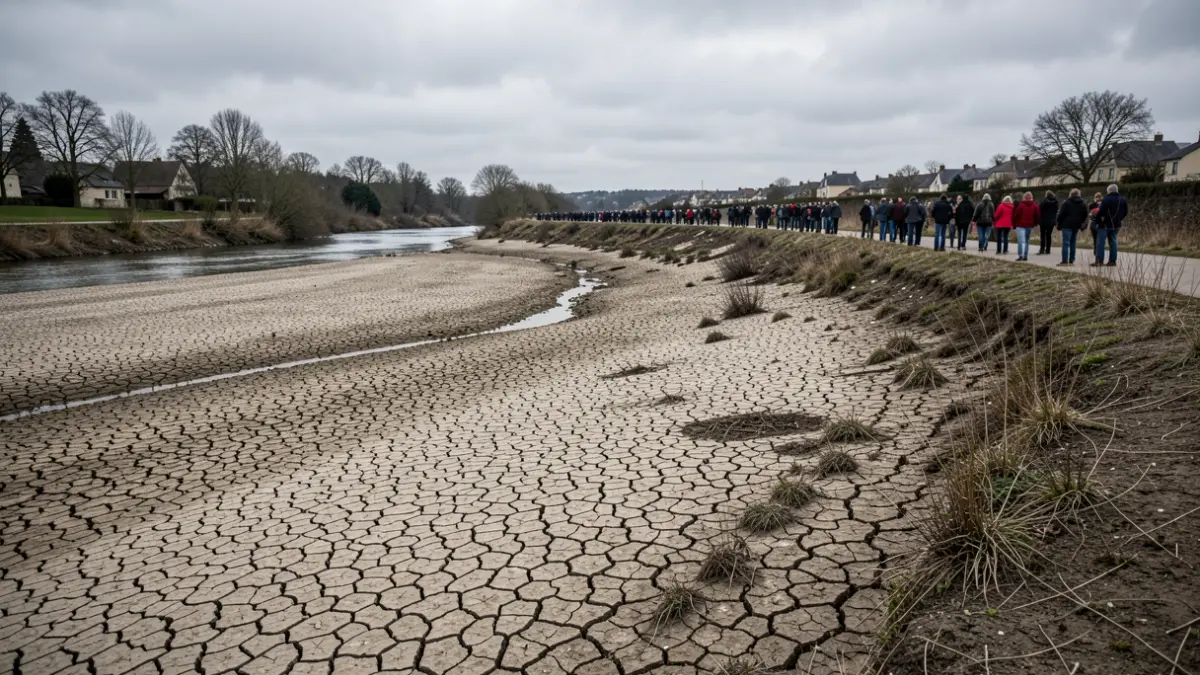
The natural decrease in river flow during periods of low rainfall is called low flow or 'étiage'. When water levels become extremely low, some sections may cease to have visible flow, a phenomenon known as 'assec', where the riverbed becomes completely or partially dry. Summer 2026 created conditions conducive to the emergence and exacerbation of dry spells in the most vulnerable sectors of the Yerres basin.
While the data confirms the extent of the rainfall deficit and the low flow rates observed this summer, it does not allow us to state that summer 2026 was the driest ever recorded on the Yerres watershed.