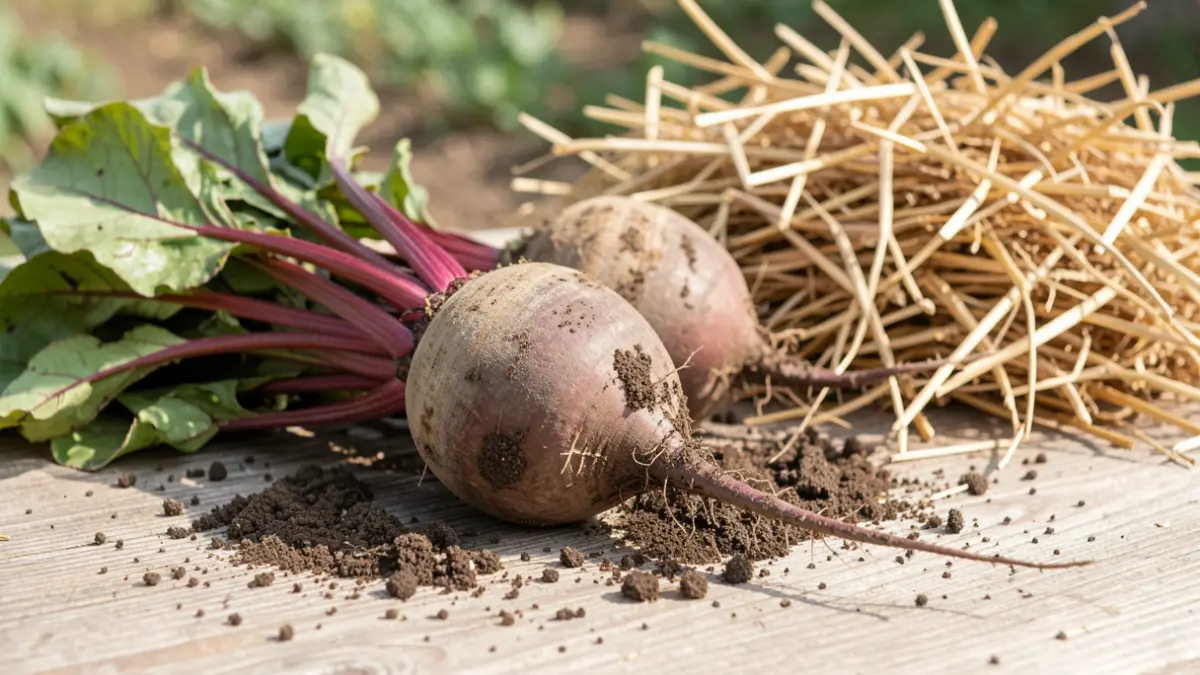
In a difficult context for the sugar beet industry, facing numerous downgrades and refusals from sugar mills, the Île-de-France Chamber of Agriculture studied the biogas potential of non-marketable beets. The goal was to test co-silage with straw to limit juice losses, a major problem linked to the high moisture content of these roots.
Results obtained by Flash BMP method indicate a potential of 66 m3 of CH4 per tonne of raw matter for degraded beets, compared to 77 m3 for healthy beets, a decrease of 14%. The remaining organic matter therefore retains an important biogas potential. On a plot where the sugar mill estimated the rate of non-marketable parts at 30%, the storage of crushed beets alone resulted in a mass loss in the form of juice of 14.9 to 17.6% after 27 days.
The incorporation of straw significantly modifies this behaviour. With an input of 7% straw in the total fresh matter, juice loss dropped to 0.1%, and was zero with 12% straw. However, the energy advantage of co-silage compared to classic storage in piles is not yet demonstrated, a significant decrease in dry matter having been observed in silages without its origin being clearly established.
For valorization at the scale of a farm or a biogas plant, the preparation of beets is crucial. Washing, stoning, and crushing are necessary to limit the introduction of soil and stones into the digester. A mobile service could be mobilised, with an announced capacity of around 1,000 tonnes per day and an estimated cost of 6 to 8 euros per tonne. Several biogas units in Île-de-France have already expressed interest.