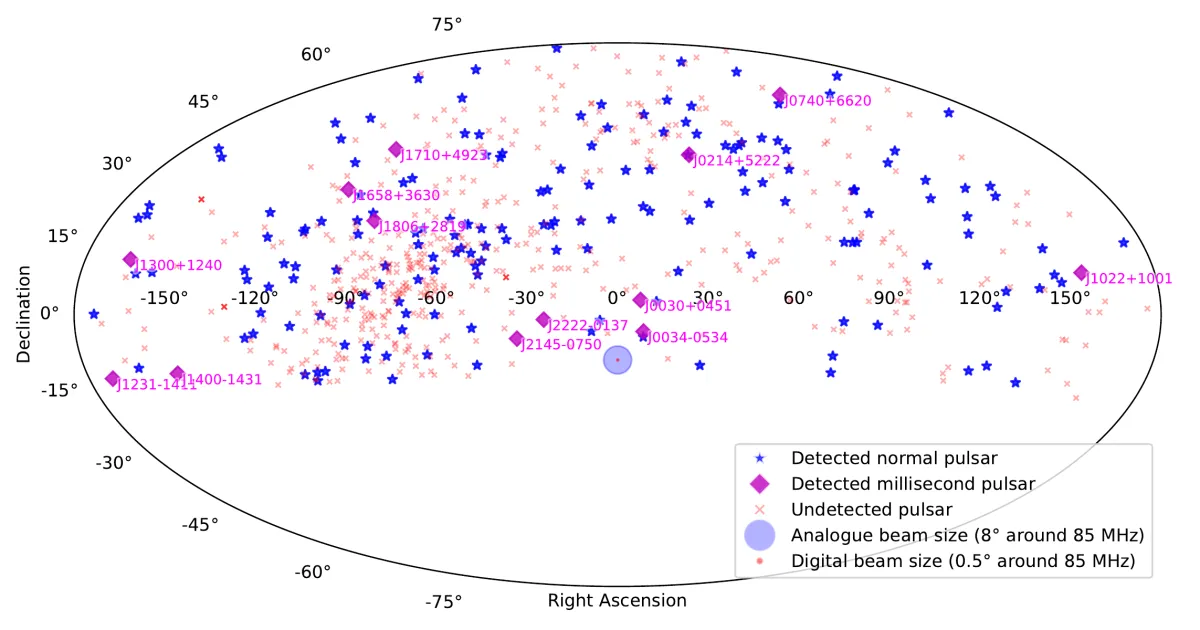
Between 2019 and 2021, the NenuFAR radio telescope, installed at the Nançay Radio Astronomy Observatory, surveyed a selection of 645 pulsars visible from the site. This observation focused on the 10–85 MHz frequency band, a region of the radio spectrum less explored for these rapidly rotating neutron stars.
The results of this campaign reveal the detection of 182 pulsars, among which 89 had never been observed below 100 MHz. This census thus brings the total number of known pulsars in this frequency band from 119 to 208. The study also identified thirteen millisecond pulsars, ten of which are new discoveries at these low frequencies.
The research team is providing detailed pulse profiles, dispersion and scattering measurements, and calibrated fluxes. This valuable data contributes to a better understanding of pulsar spectra at low frequencies and allows for probing the interstellar medium.
This collaborative effort involved the Paris Observatory - PSL (ORN), the LIRA, as well as numerous French and international partners, including LPC2E/OSUC, ASTRON, and the Institute of Radio Astronomy of Kharkiv in Ukraine.