Some materials not only retain the trace of what they have undergone but also how it happened. This is shown by a recent study on so-called 'frustrated' materials, subjected to incompatible constraints that prevent them from adopting a unique configuration. In these systems, the path followed by the stresses is as important as the endpoint.
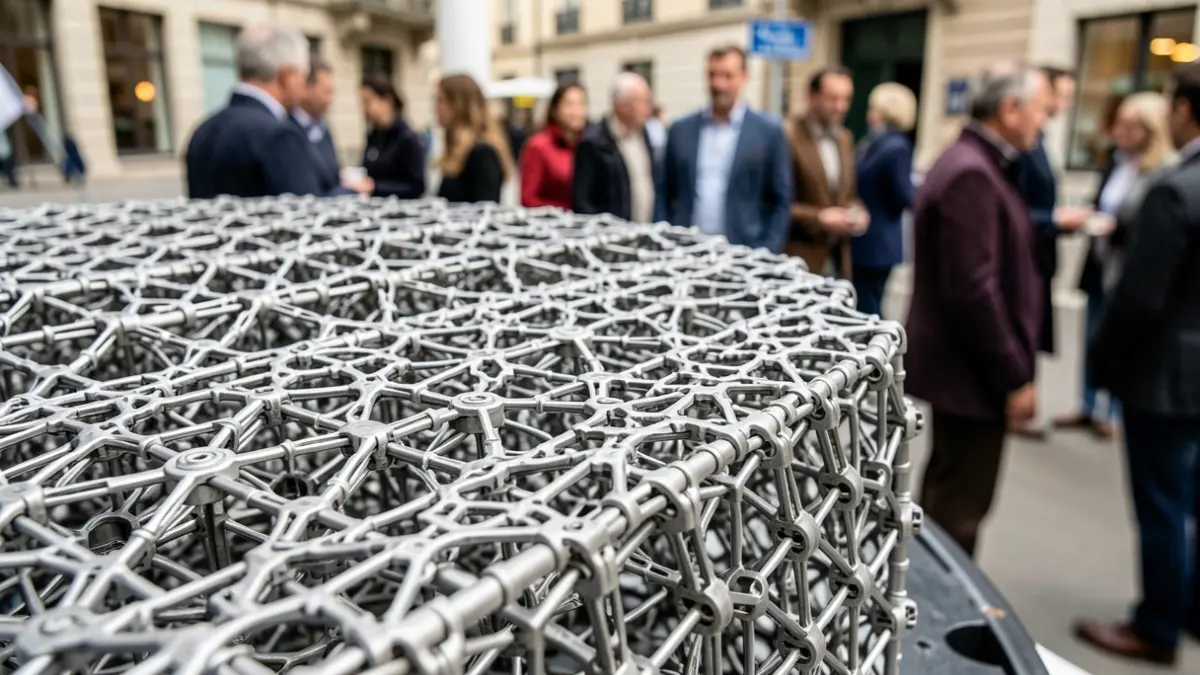
The researchers studied a mechanical metamaterial composed of coupled elastic elements, capable of switching between several stable states. By applying local compressions successively at different locations, they observed that the order of these compressions changes the final result. Thus, soliciting zone A first and then zone B does not necessarily lead to the same state as doing the reverse.
This behavior, referred to as 'non-abelian' in physics, is comparable to a combination lock where the order of actions is crucial to achieve the desired outcome. The study also highlights that this material memory can be described in a structured manner, with different states and transitions representable as graphs, reminiscent of sequential circuit logic where the response depends on the history of previous inputs.
Another interesting finding is that the behavior of the same sample can vary depending on the intensity of the applied stresses, and that certain responses can even be reprogrammed by new mechanical sequences. The number of cycles required to reach a stable regime also depends on the direction in which the stresses are chained.
While these works do not yet propose a ready-to-use mechanical computer, they demonstrate how to exploit the inherent memory of complex materials for information processing. In the long term, this type of approach could inspire materials capable of combining deformation, memory, and computation within a single structure.
The research was conducted by Matthieu Labousse and Paul Turpault from ESPCI Paris - PSL, and published in the journal Physical Review X.