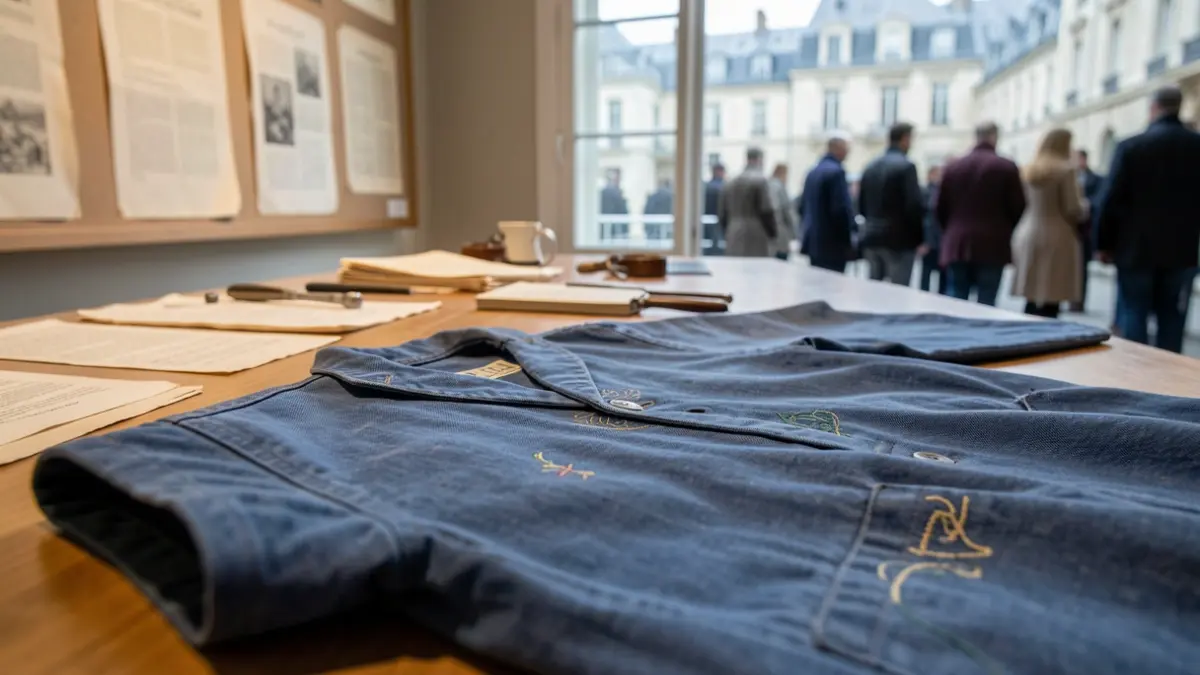
The exhibition "Sous toutes les coutures - Le vêtement au travail", held from April 8 to September 21, 2026, offered a deep dive into the history of professional clothing. It unveiled more than two centuries of social, technical, and aesthetic evolution, from early uniforms to haute couture creations, including protective wear and, later, women's attire. This sensitive and documented exploration highlighted the relationship with work, power, and identity through these garments.
Wearing a uniform, work overalls, or a company outfit is a simple yet meaningful gesture. Professional clothing synthesizes societal changes: hierarchies, social progress, transformations in work, and the affirmation of individual rights and aspirations. The exhibition showcased an exceptional collection of historical and contemporary pieces, organized into three sections: "authority attire," "protective attire," and "1990-2025: a new era."
The exhibition began in the late 18th century with the appearance of the first civilian uniforms. In the 19th century, strict military cuts, braids, and cockades dominated, with uniforms serving to identify and hierarchize. Under the Third Republic, it became a symbolic tool of public authority, distinguishing professions like postal workers, police officers, and telegraph agents. In the 20th century, these outfits gradually became more civilian, with emblems replaced by logos and modernized cuts.
For a long time, specific workwear did not exist; everyday clothes were adapted with layers and artisanal protections. The work smock, from the 1830s, marked a first evolution. Industrialization and hygiene then led to a codified wardrobe to address new dangers. The exhibition also highlighted the historical absence of dedicated clothing for women, whose professional attire only truly appeared in the 20th century.
From the 1980s-1990s onwards, public administrations engaged stylists and fashion houses to modernize their uniforms, such as Balenciaga or Balmain. Today, professional attire integrates issues of brand image, ergonomics, technical performance, and durability, with the rise of recycled textiles and the circular economy.