A new study published in Science Advances offers a revised perspective on the accretion of Earth and other terrestrial planets, proposing that the elements essential for life's development may have been present on Earth much longer than previously believed. This research questions the 'late veneer' theory, which posited a late delivery of material via meteorites.
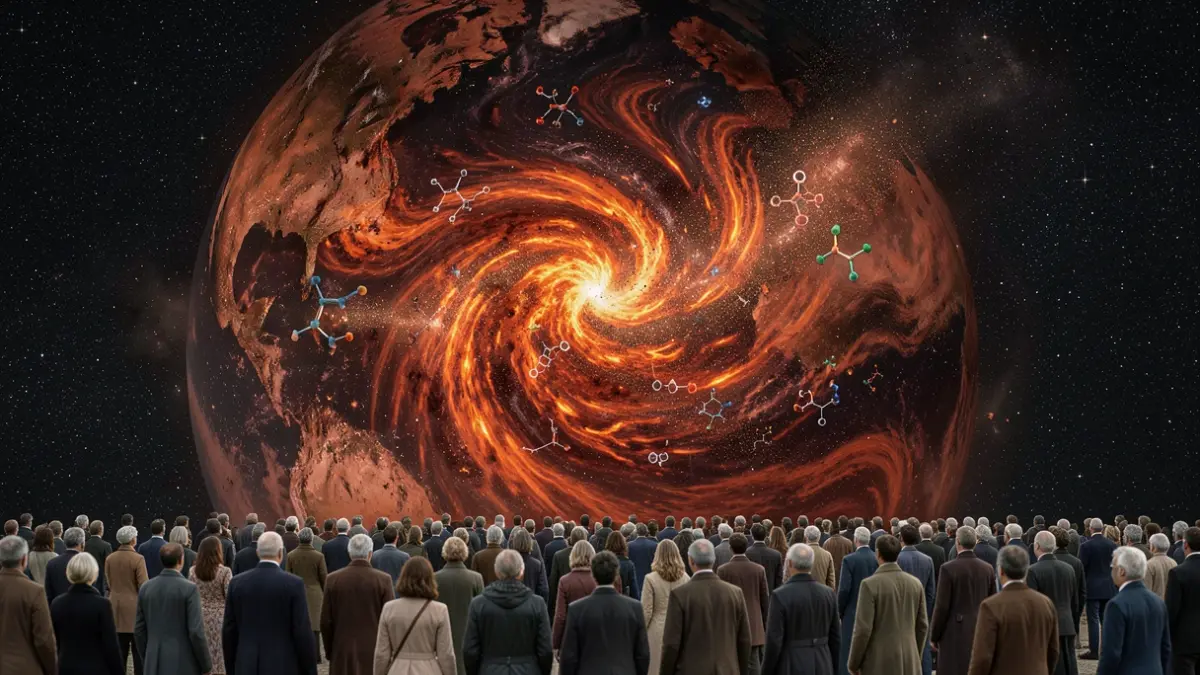
Earth's formation, 4.5 billion years ago, involved collisions of meteorites. In the 1970s, the 'late veneer' hypothesis was proposed to explain the high concentrations of highly siderophile elements (like gold and platinum) in Earth's mantle. These elements, with a strong affinity for iron, were thought to have been delivered by meteorites after the planet cooled. This hypothesis also served to explain the arrival of elements necessary for life.
The Sorbonne University study presents an alternative scenario where extreme conditions during Earth's formation explain these concentrations without the need for a massive late delivery. If the 'late veneer' was less abundant, the arrival of life's ingredients via this mechanism becomes difficult to explain. The study thus suggests these elements were present from the beginning.
Researchers recreated laboratory conditions simulating Earth's differentiation pressures and temperatures (hundreds of thousands of times atmospheric pressure and thousands of degrees Celsius). During this phase, the planet was covered by a magma ocean where elements separated based on their affinity for metal or magma, forming the metallic core and silicate mantle. This core-mantle differentiation, lasting tens of millions of years, sealed off chemical exchanges.
Using diamond anvil cells and laser heating, sample analysis revealed that temperature played a predominant role in the partitioning of highly siderophile elements (gold, rhenium, palladium, iridium, osmium) between the core and mantle. Under these conditions, these elements are less siderophile, and their affinity for silicates increases. Numerical models confirm that high temperatures during Earth's differentiation explain the mantle concentrations of these elements.
This finding provides a new view on the accretion of Earth, the Moon, and other terrestrial planets without requiring a significant 'late veneer'. This is a major advancement, as the 'late veneer' had been proposed for decades as the vector for volatile elements essential for life. The study concludes that elements like water and carbon were present very early in Earth's history.
This article is republished by The Conversation under a Creative Commons license. It is based on the work of Ingrid Blanchard, a CNRS research fellow at the Institute of Mineralogy, Materials Physics, and Cosmo-chemistry (IMPMC) at Sorbonne University.