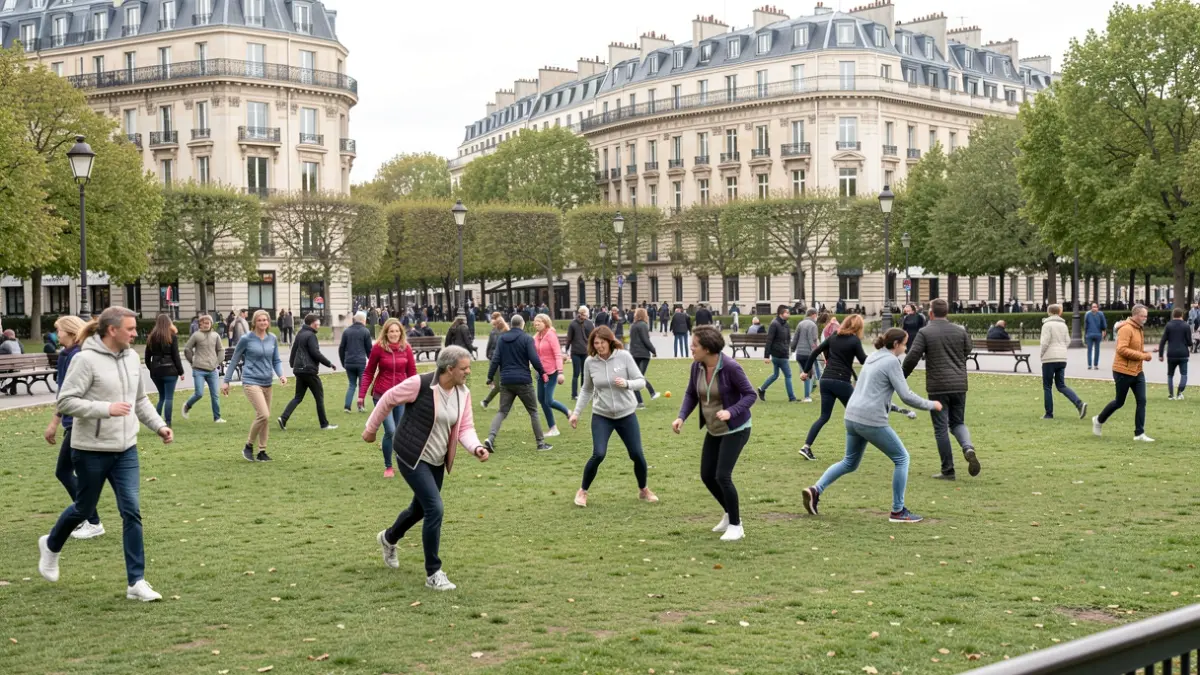
The traditional concept of the sporting city, focused on dedicated facilities such as gymnasiums and fields, is changing. Sports practices are now extending beyond their intended frameworks, with people running in public spaces, appropriating parks for training sessions, and seeking greater flexibility in schedules. According to the Institut Paris Region, nearly 70% of Île-de-France residents engage in physical activity at least once a week. However, the ways of practicing are transforming, with the emergence of new disciplines like padel and increasing collaboration between private actors and local authorities for event organization.
These new, free practices, while requiring less concrete infrastructure, challenge the use of existing facilities often designed for codified disciplines. Tennis exemplifies this shift: despite a significant number of licensed players and courts in Île-de-France, expectations are moving towards other racket sports and more diverse audiences. The question for local authorities is therefore no longer just about building, but about rethinking the use of current infrastructure.
The municipality of Athis-Mons is participating in the "Quartiers Métropolitains d’Innovation (QMI)" program, led by the Métropole du Grand Paris and operated by Paris&Co. This initiative aims to experiment with concrete solutions to adapt cities to evolving uses and future challenges. Six projects have been selected, three of which focus on sports. Paris&Co acts as a neutral intermediary, facilitating collaboration between local authorities, entrepreneurs, and residents to define needs, secure testing, and generate learnings.
Among the experimented projects, SAU VRIDERS offers a virtual reality headset combined with a bicycle to encourage physical activity among sedentary individuals. An initial challenge was the complexity of setup, a hurdle to overcome for larger-scale deployment. The Brio Studios project aims to optimize space utilization by connecting unoccupied corporate premises with individuals or coaches. In Athis-Mons, it was observed that municipal halls are already heavily utilized by associations, highlighting the need for additional human resources to open these spaces.
TennisPark proposes an innovative approach to democratize access to racket sports by allowing multiple disciplines to coexist on the same court, using a color-coded system. This initiative questions the ability of local authorities to better utilize their existing facilities amidst constraints of land, budget, and staff time. Athis-Mons has also increased outdoor street workout equipment and created health trails, choices aimed at both accessibility and reclaiming public space.
Faced with financial constraints, the municipality of Athis-Mons has realized that the general interest no longer requires managing everything in-house. The QMI program has encouraged collaboration with private and inter-municipal partners. Paris&Co, with its expertise in sports startups, supports these actors in evolving their business models, which are now oriented not only towards the general public but also towards companies and local authorities. Sports innovation is judged by contact with practitioners, and private interest can complement public interest within a defined framework.
Climate change adds a new dimension to outdoor sports, necessitating a reflection on 'when' and 'how' to practice. Optimizing existing resources becomes a crucial issue, especially as Île-de-France land is scarce and expensive. Cities like Le Havre, Plaine Commune, and Bordeaux are leading the way in adaptations to heatwaves. The legacy of the Paris 2024 Olympic Games also translates into increased sports infrastructure, such as the Olympic Aquatic Center in Saint-Denis and the reopening of swimming sites. The challenge remains to sustainably integrate these uses into urban planning.
The QMI program extends beyond sports. Other projects explore diverse fields: valorizing date pits as a coffee substitute, assisting local authorities in preparing for crisis management exercises (health, environmental, media), and analyzing resident requests to better understand their needs for services and products in the territory. The method remains the same: confronting a real need with practical field testing to find concrete solutions.