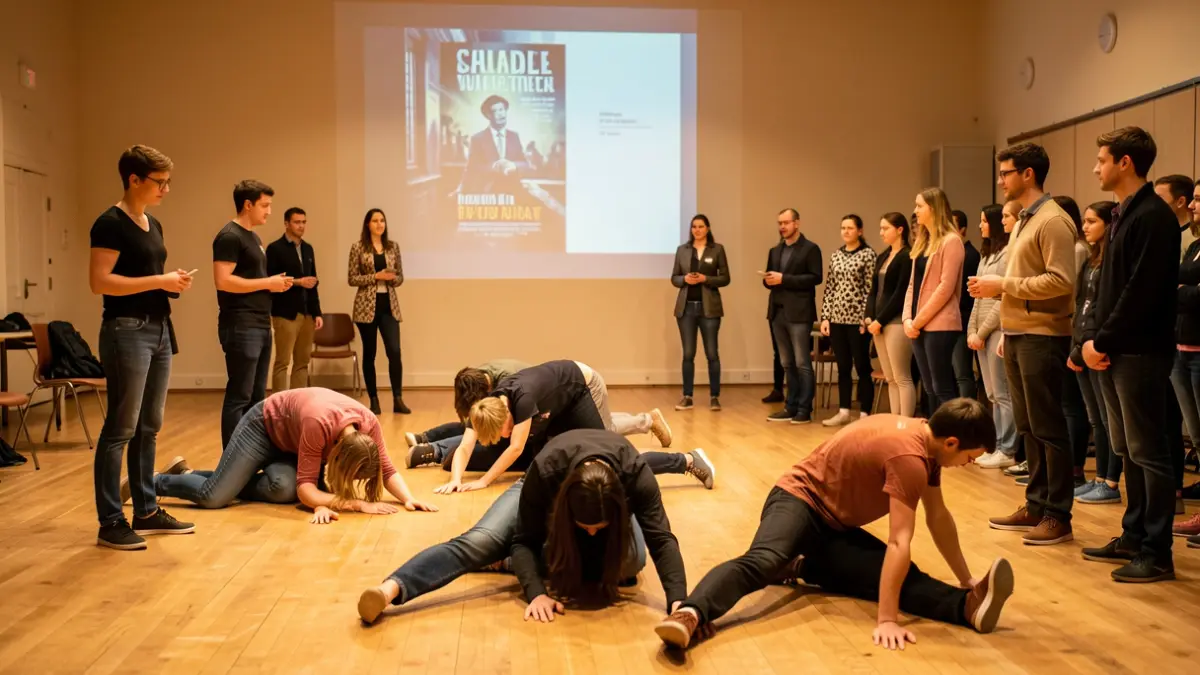
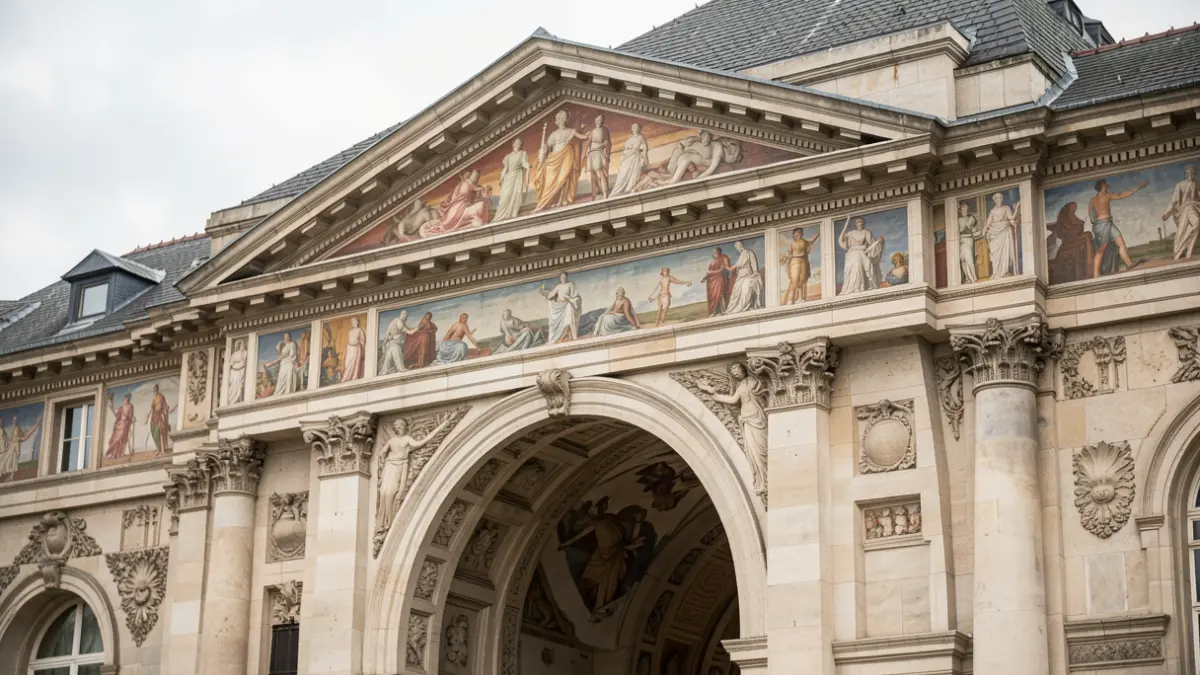
In late May, in room N6 at La Villette, about twenty young actors and actresses warm up on the floor, led by one of their peers. Nearby, the facade of the Grande Halle displays "Le Tartuffe ou l’Hypocrite" by Ivo Van Hove, a play the students had seen a few days prior. It is this work that Emma Laristan, an actress and former Comédie-Française member, proposes they explore during this three-day workshop. This project, a collaboration with the Comédie-Française and La Villette, is supported by Isabelle Mestre, a teacher at the Conservatory. As part of this initiative, the students also worked with choreographer Emanuelle Soum and met with a stage manager from the Grande Halle.
Prior to the workshop, Emma Laristan had asked the students to choose a scene partner and prepare a specific scene (Act III, Scene 3 or Act IV, Scene 4) as if they were going to perform it publicly. The majority opted for Act III, Scene 3, where Tartuffe declares his passion for Elmire. This scene, longer than the typical format for drama school entrance exams, offers, according to the actress, a "true character journey" and "forces one to make choices."
After two days of work and discussion on the meaning of Molière's play and Ivo Van Hove's version, the students present their scenes. The interpretations vary considerably, as exemplified by Tartuffe's tirade, "pour être dévot, je n’en suis pas moins homme" (to be devout does not make me less of a man), delivered differently by Valentin (sensual), Mila (reasoning), or Milo (disturbingly fetishistic).
Emma Laristan encourages all approaches, emphasizing that there is "no false or true, there are as many possibilities to explore this scene as there are actors in this room." After their initial presentation, she guides them on their choices, prompting them to reflect on their preparation: "How did you work this scene?"
Thaïs and Valentin drew a parallel with "Phèdre," but the idea became somewhat diluted. The young man created a chastity belt for his Tartuffe using heavy tape, with Elmire holding the key, a proposition lacking clarity. Emma Laristan often points out a lack of preparation regarding the narrative: "It is necessary to be precise about who is present, why I enter, what my objectives are, what the relationship is between the two characters, in what space it takes place." She sometimes moved the students to incongruous locations to show them how the delivery could be altered.
Mila chose to fully explore the "false devotee" aspect, while her partner Loup adopts a different register, illustrating that "two actresses who do not have the same project at all." Emma Laristan then proposes a new premise, transforming an initially shaky scene into a highly successful comedic sequence, played on either side of an imaginary confessional, improvised with an overturned table.
The students, aged 19 to 25, benefit from this intensive practice. Thaïs, 21, a student of theater studies at Sorbonne Nouvelle, finds working on the same scene intensively very beneficial. Inès, 20, in her third year, has been involved in theater, music, and dance since the age of 6.
“"We don't play at all the same way if we are in a bedroom, in a cemetery, or between two doors… I sometimes moved them to incongruous places so they could see how the delivery could be changed."
Isabelle Mestre leads open classes, mixing cycles and working in troupes for greater interest. She organizes these workshops with La Villette to offer students a different approach to the stage, a practice that is rare and highly appreciated in district conservatories.
“"I find them really working, they are attentive, curious, which is the primary quality of an actor."
A bilingual actress trained in England, where she notes "less of a star phenomenon and more of a troupe craft," Emma Laristan shares her advice: "work on your stakes, talk to each other a lot. Actors don't prepare together enough. Your partner is really there to pull you out of yourself." She emphasizes the importance of the other in her method and encourages students to build their own "toolbox."
“"Often, I point out a lack of preparation regarding what we are telling each other. It is necessary to be precise about who is present, why I enter, what my objectives are, what the relationship is between the two characters, in what space it takes place: we do not play at all the same way if we are in a bedroom, in a cemetery, or between two doors… I sometimes moved them to incongruous places so they could see how the delivery could be changed."
“"work on your stakes, talk to each other a lot. Actors don't prepare together enough. Your partner is really there to pull you out of yourself."
Photos: Joseph Banderet. Texts: Vincent Théval. The Malakoff Humanis Handicap Foundation supports accessibility projects at La Villette.