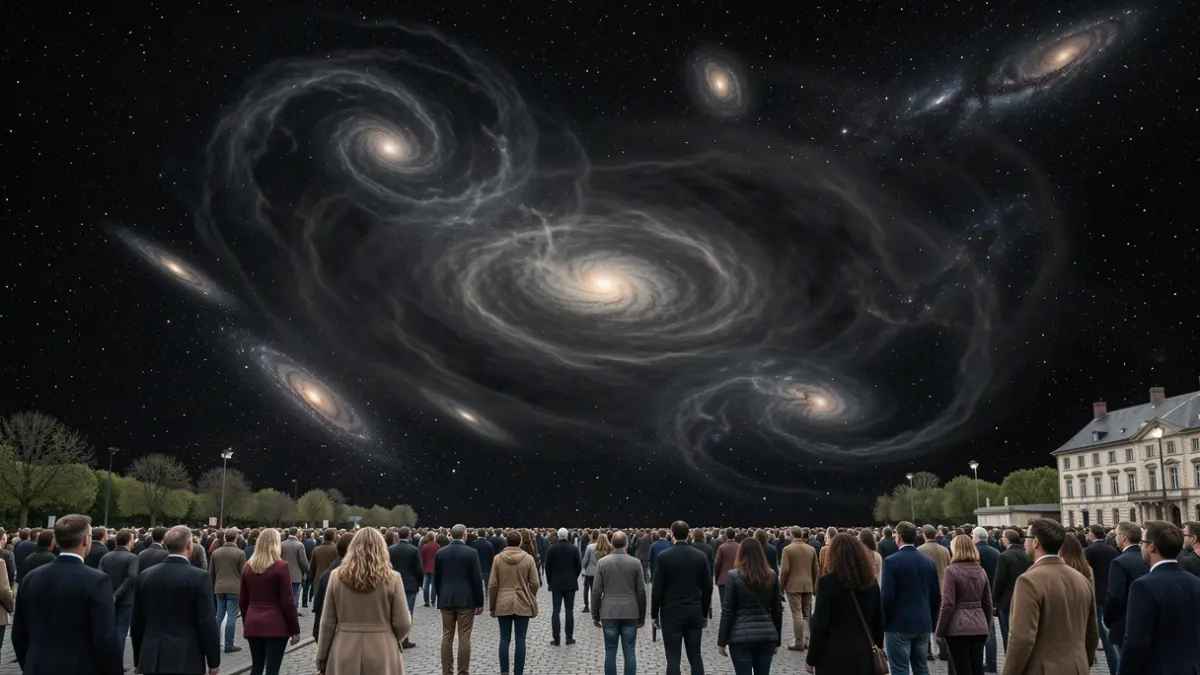
An alliance between artificial intelligence (AI) and cosmology is emerging thanks to the work of researchers at CEA-Irfu, in collaboration with Imperial College and University College London. This new method for analyzing cosmological data, which combines traditional statistics with AI tools, could significantly improve our understanding of dark matter and dark energy. These components, making up 95% of the Universe's content, remain among the greatest scientific mysteries.
This approach aims to more effectively exploit the immense volumes of data collected by major astronomical surveys, such as the Euclid mission or the Legacy Survey of Space and Time (LSST) from the Vera C. Rubin Observatory. The goal is to better read the Universe by analyzing the subtle distortions of distant galaxies.
Dark matter, though invisible, reveals its presence through its gravitational influence. Light from distant galaxies is deflected on its journey to Earth by the attraction of intervening matter, causing a slight distortion in their image, a phenomenon known as weak gravitational lensing. These minute distortions, barely perceptible for a single galaxy, become a powerful probe of matter distribution, and thus dark matter, when analyzed across millions of galaxies.
« Most analyses simply study the correlation between pairs of galaxy shapes based on distances. This only captures a part of the information contained in the data. In our analysis, we use AI to identify the most informative features in the data, » explains Natialia Porqueres, a researcher at CEA-Irfu.
The method was applied to data from the third year of the Dark Energy Survey (DES), which mapped the shapes of approximately 100 million galaxies. This hybrid analysis, developed by PhD student Lucas Makinen, combines established cosmological techniques with AI-enhanced summary statistics, all within a framework that carefully tracks data uncertainties.
« This method is innovative. [...] Applied to the weak gravitational lensing data from the third year of DES, this method provides the most precise cosmological constraints ever obtained based solely on the weak gravitational lensing effect, for both the Universe's matter density and the intensity of cosmic aggregation, » testifies Natalia Porqueres.
The results are also consistent with measurements from the Planck satellite, which mapped the cosmic microwave background radiation left over from the Big Bang, thus helping to resolve a long-standing divergence between different methods of observing the Universe.