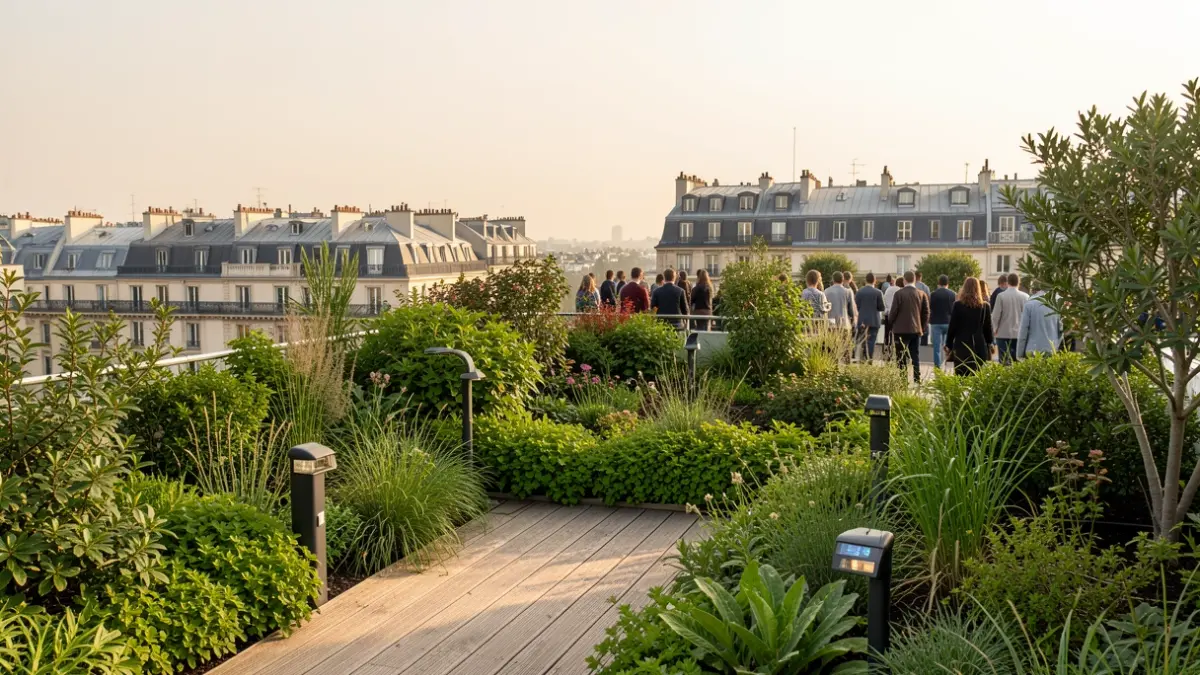
Paris crossed a historic threshold on September 15, 2026, recording its hundredth day at 25°C or above. This figure, unprecedented since records began in 1872, underscores the climate emergency. On the roof of the Académie du Climat, a vegetated platform experimented by Roofscapes helps reduce the temperature by approximately 14°C above and below the zinc. In the courtyard, a water-autonomous shade structure installed by Source Urbaine has not required watering since 2024, demonstrating the effectiveness of measured solutions.
Paris's history shows that urban cooling is not a new discovery. As early as 1872, the capital was equipped with Wallace fountains to provide drinking water. Today, the question is no longer how to cool a city, but how quickly a dense metropolis can translate its knowledge into concrete actions. The total number of hot days masks a worrying reality: May had 13 hot days (compared to an average of 5.6), June had 20 (compared to 10), July had 29 (compared to 19), and August had 24. September already had nine by the 13th, with a monthly average of five. Heat is becoming a persistent issue, transforming Paris into a city designed for a different climate.
Nationally, July 2026 was the hottest month ever recorded in France since 1900. Paris is warming faster than the average, with a 2.3°C increase since the pre-industrial era. Parisian buildings, particularly the zinc or slate roofs (up to 80%), amplify the phenomenon, reaching surface temperatures of 62°C, even 70°C. These extreme conditions directly affect residents, many of whom sleep under these overheated roofs.
The reference trajectory TRACC forecasts a warming of 2°C by 2030 and 4°C by 2100 for the metropolis. Faced with this reality, the City of Paris, through the Urban Lab and Paris&Co, has been experimenting with solutions since 2017. Initial experiments, followed by projects like Urban Canopee's vegetated canopy, have shown public adoption. These initiatives aim to adapt the city to a changing climate, but their large-scale deployment faces obstacles.
The first obstacle is heritage protection, which preserves buildings adapted to yesterday's climate. The bioclimatic PLU is beginning to favor greening, but does not finance the work. The second obstacle is a lack of coordination: experiments create networks, but financing adaptation remains a public-private cooperation issue. The REMpart guide highlights this need. Meanwhile, the low-tech approach, promoted by Paris&Co, offers sustainable and simple solutions, such as Mube's vegetated masts, which raise the question of cost versus alternatives.
In the face of urgency, signs of change are emerging. The APEx (Exemplary Parisian Architectures) initiative supports bioclimatic projects. However, the widespread use of individual air conditioners, while understandable due to unlivable housing conditions, exacerbates urban heat. Alternatives exist, but reality shows an opposite trend. The question is not why Parisians buy air conditioners, but why they have no other solutions available. Individual adaptation does not solve a collective problem, and responsibility must be shared among citizens, businesses, and public authorities.
Adapting the city without reducing emissions is like running on an accelerating treadmill. Innovative solutions do not replace collective decision-making or reduction efforts. Paris's transformation will depend on the city's ability to make decisions based on evidence and to generalize proven solutions, like those from the Académie du Climat, to cope with a rising climate.