The Regional Quarry Scheme (SRC) for Île-de-France was officially approved on September 30th by the Prefect of the Île-de-France region. This strategic planning document, established by the 2014 ALUR law, aims to reconcile the territory's needs for quarry materials and substances with an economical and rational management of mineral resources.
Facing an annual consumption of over 30 million tons of aggregates, essential for constructing buildings and infrastructure, this plan is highly relevant. Developed in consultation with the industry, it integrates the entire activity chain: from extraction to use, including regional logistics.
The Île-de-France SRC aims to meet the material needs essential for the region's development, improve the management and transport of these non-renewable resources through the circular economy (reuse, recycling, inert waste valorization) and the use of alternative materials. It also incorporates the national low-carbon strategy and climate change adaptation challenges, as well as compatibility with territorial coherence schemes (SCoT) and local urban planning documents (PLU).
Île-de-France consumes 31 million tons of aggregates annually, or 2.6 tons per inhabitant, and depends on external supplies for over 50%. The transport of these materials represents a major logistical challenge, promoting the development of the river network as an alternative to road transport.
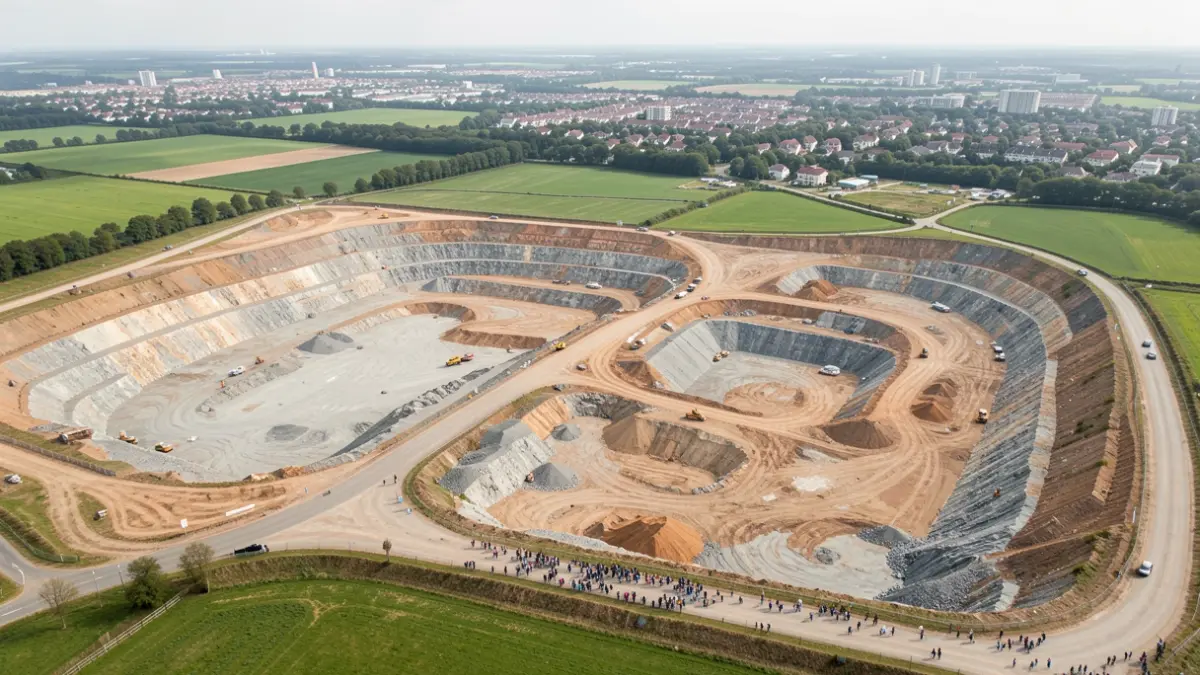
In 2024, the region has 74 authorized quarries, covering aggregates, industrial materials and minerals, and ornamental stones. Activity is concentrated in the outer suburbs, particularly in Seine-et-Marne (51 sites), Yvelines (10 sites), Essonne (7 sites), and Val-d’Oise (4 sites).
Given the increasing demand generated by major regional projects, the plan encourages resource-efficient construction, prioritizing recycling, bio-based materials, and the reconciliation of environmental challenges. Projects like the La Vallée eco-district in Chatenay-Malabry or the Paris 2024 Olympic Village illustrate this reasoned management, with the Olympic Village notably using a significant proportion of wood and low-carbon concrete.
The regional quarry plan outlines the needs for mineral resources, identifies potentially exploitable deposit areas, analyzes material flows, and sets a framework for quarry operation, development, and site restoration.