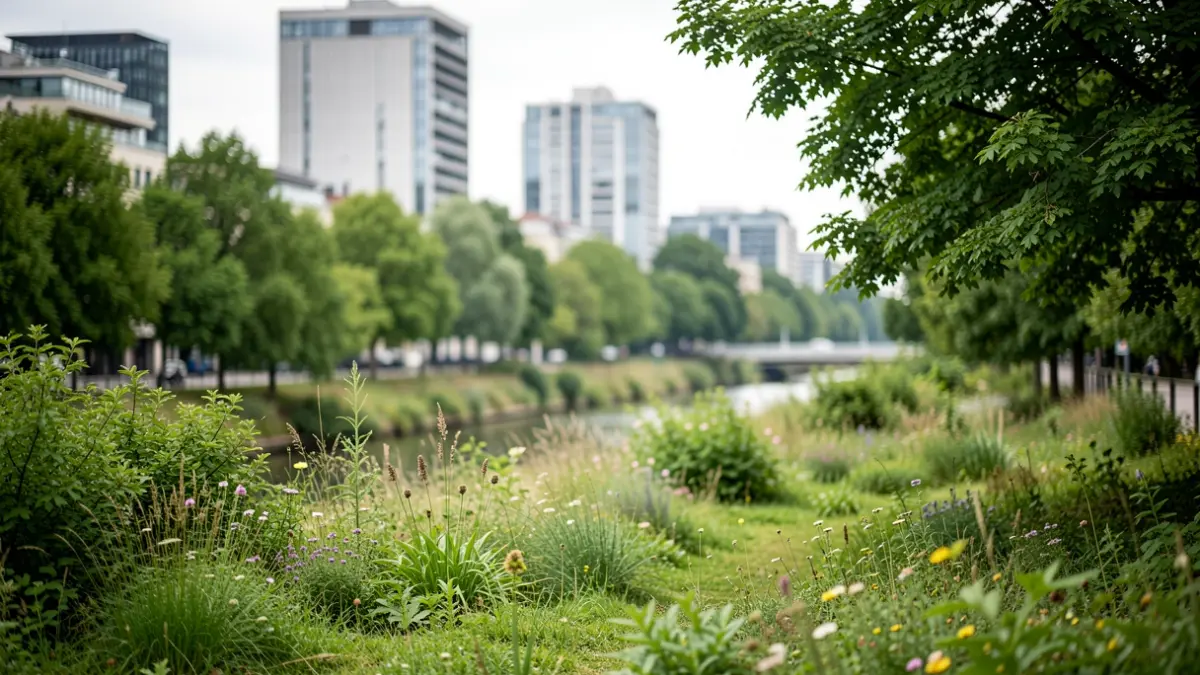
In response to the urgent need to rewild the city and the multiplying summer heatwaves, the FAR (Fictions d'Anticipations de Renaturation) project, led by Joffrey Lavigne, a student at the National Museum of Natural History, is exploring the possible futures of the territory with the residents of Plaine Commune. This initiative, supported by the Regional Agency for Biodiversity in Île-de-France, a collective of artists, and scientists, blends arts, sciences, and imagination to rethink urban ecology.
Launched in 2024, the FAR project offers a sensitive approach to territorial futures, using science fiction and the arts to question urban planning policies. "The idea with FAR is to propose, through workshops with residents, alternative realities and futures, and to address very contemporary issues like pollution and climate change through a thought exercise," explains Joffrey Lavigne, a doctoral student at the Center for Ecology and Conservation Sciences (CESCO). These imaginaries are then staged and visualized to fuel research and debate.
Funded by the ERABLE program, which supports local authorities in narrating biodiversity, the project aligns with the National Biodiversity Strategy 2030. It aims to generate knowledge through dialogue between social sciences and life sciences. "With FAR, we are not conducting formal consultation. I believe there is a political dimension to fiction. Thinking about the future is a skill like any other; it invites projection into the future, allowing for anticipation and adaptation… an exercise that might be more familiar to higher socio-economic groups, yet the idea is to bring together different types of audiences in these workshops to collectively develop these collective imaginaries," Lavigne notes.
Since the beginning of 2025, Joffrey Lavigne and a collective of artists (graphic designers, designers, writers, landscapers, actors, visual artists) have organized 45 workshops across the nine towns of Plaine Commune. These playful workshops, guided by cards and "geniuses," aim to explore themes such as the territory's environmental memory, current fears (harmful species, pollution), and future aspirations (seeing stars again, hearing birdsong).
Participants' ideas and projections come to life through various narratives: systems to listen to buried watercourses, floating gardens, a giant cable car replacing the A86 to rewild the former highway, or giant wish trees in town centers. "There are many dreamlike elements, sometimes dystopian too, like the idea of artificial birds serving as surveillance drones…," recalls Joffrey. These fictional contents are analyzed by researchers such as Aurélie Coulon, Cécile Albert, and Camille Antigny.
Illustrations by landscape artist Clémence Mathieu, drawn from the narratives, will form a traveling exhibition starting next December. Writing and theatrical performances in partnership with the Théâtre de l'Opprimé are also planned.
In the face of record summer temperatures, the FAR project's anticipatory fiction captures residents' feelings. "The issue of climate change is everywhere, even if not addressed head-on. There are recurring needs for coolness and water," explains Joffrey. Proposals include rain gardens, dams for canals, and a new relationship with water. The project also critically examines concrete development, expressing a need for breathable spaces and a visual sense of suffocation.
The FAR project, concluding in spring 2027, aims to reflect these representations and imagine alternative futures. "How to create a large enough breach in the present for multiple futures to enter," concludes Lavigne.
As part of the 2026 European Heritage Days, on September 19th, the FAR project was presented at the Aimé Césaire Media Library in La Courneuve with the exhibition-debate "The Living Heritage of La Courneuve in 2126, a Hybrid Future!". This exhibition, featuring illustrations and narratives, allowed participants to share their dreams for the city of tomorrow.